Dialogues: the plain everyday language people really use, practiced line by line
Dialogues are short, real conversations from everyday life: sending a parcel at the post office, paying at a convenience store, getting a haircut, seeing a doctor, asking the way, renting a flat… Each language has 40+ scenes written in the plain language locals actually use, not textbook speech. Every line can be read aloud and comes with a translation, and you can look at the translation first and guess how to say it.
- Pick a scene: e.g. “At the post office”
- Play all: Male and female voices
- Guess first: See the translation, say it
- Reveal the answer: Compare and repeat
- Save key phrases: Find them again later
1. Choose a scene
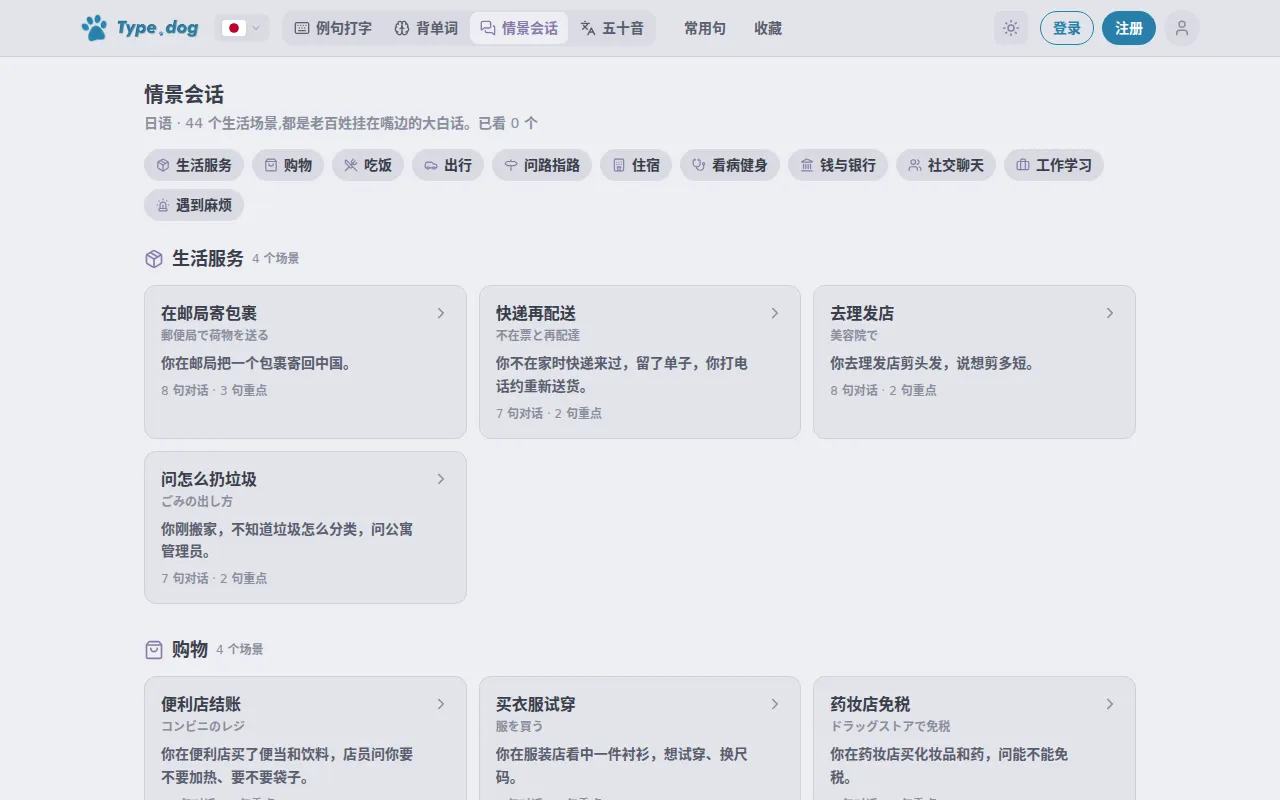
Scenes are sorted into 11 groups: daily services, shopping, eating out, getting around, asking the way, accommodation, health, money and banks, socializing, work and study, and when things go wrong. Each card shows a short description, the number of lines and the number of key phrases. English also has a special “US visa interview” set.
2. Playing and practicing
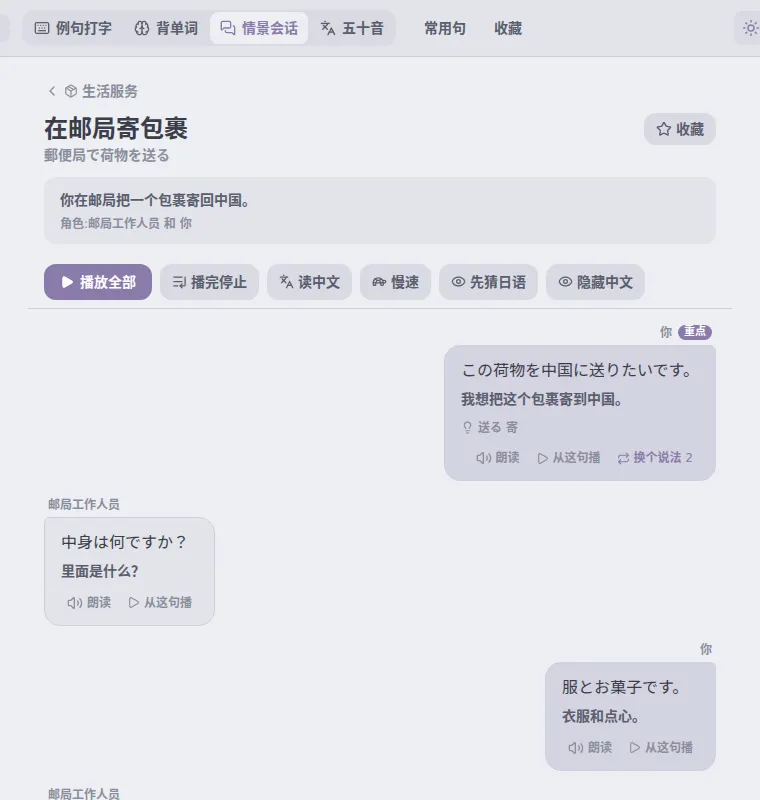
| Button | What it does |
|---|---|
| Play all | Read the whole dialogue aloud, by role |
| Stop / loop / play next | What happens after the dialogue ends |
| Read translation | Read each line’s translation after the original |
| Slow | Slower speech |
| Guess first | Show only the translation; think of the line yourself, then tap the bubble for the answer |
| Hide translation | Show only the original, to check whether you understand it |
| “Play from here” and “Say it differently” on each line | Start in the middle; see other ways to say the same thing |
- 💡 Tap any word in a line to look it up.
- 💡 “Key phrases” collects the key lines from every scene in one place; “Favorites” holds the scenes you saved.
Listening on a phone
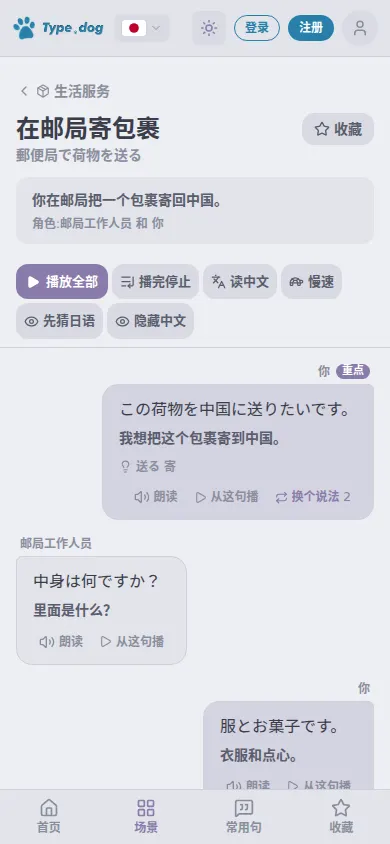
On a phone, turn on “Play all + play next”, put your headphones on, and you have your own language radio.
FAQ
Which languages have dialogues?
All 7: English, Japanese, Korean, German, French, Italian and Spanish, with 40+ scenes each.
Can I read the dialogues without logging in?
Yes. The public dialogue pages at type.dog/dialogues show the full text and translations; to hear them read aloud or save favorites, click “Try it without signing up”.